October/2026
You can't vote for it. But with most parties offering only glib promises and little thought on an issue so important to everyone, the people need a voice. I've been critical of many aspects of our health system and tried to gather data to support those criticisms. Because I think it's not only important but possible for us to do better. What would I change? Glad you asked. Here's what I'd like to see. It doesn't cover everything, but it's the right mix of solutions that BC needs right now.
I'd love to see every party steal this and adopt it. But most are still focused on fear, lies, and pithy soundbites, not real change. You'll find a fair bit of this in the CentreBC platform (full disclosure, I had some input to it as a volunteer, and if they had more time, likely more would have). Other bits you'll see appear in in other parties' platforms and statements. My allegiance isn't to any one party, but to fixing our health system. Demand better. Demand that governments, who are happy to spend your money, deliver on what's important to you. They work for us. Not the other way around.
Roadmap to the better public health system BC needs today:
Transformational Change Within our Means
Where are we now?
After 10 years of NDP rule, spending and administration have skyrocketed, but health services are in serious decline. All while the government denies reality, gaslights the public with cherry-picked spin, and passes off "we're doing our best" as a plan.
- Front-line professionals are overwhelmed by increased demands, lack basic support or autonomy, and are demoralized, silenced... and leaving.
- Patients have seen access to critical services plummet, waiting lists explode, and standards of care evaporate, with huge regional disparities.
Pledge on Health Care:
- Prioritize results over spending: stop throwing billions at health without public accountability
- Deliver an efficient, effective, public system of universal access to essential health services
- Respect, support, and empower front-line professionals and patients
Jump to: PRIMARY CARE | SPECIALISTS | EMERGENCY ROOMS | VALUING HEALTHCARE PROFESSIONALS | PRIVATIZATION
Some highlights:
- create a public dashboard of comprehensive performance indicators to target and eliminate regional disparities
- increase clinician autonomy, decrease centralized control, restore rules-based patient-centred incentives for effective, team-based front-line care
- support clinicians to adopt, share, and scale best practices and experiences openly and honestly
- replace the culture of secrecy, spin, intimidation, and retribution with transparency
- boost productivity and respect finances: public performance audits and streamlining / decentralization of key programs
TWO BIG SHIFTS in how we MANAGE our healthcare system:
- Shift from a culture of secrecy and "good news only" to full public accountability and transparency.
- Shift from a top-down bureaucratic model of control to bottom-up, rules-based decision making with effective oversight.
Or to put it more bluntly:
- Established shared goals and foundations
- Align incentives
- Get the hell out of the way
- Monitor, share, improve
The first shift will restore public trust and financial discipline, make shortcomings visible, and drive improvements based on demonstrated need.
The second shift will increase productivity, make effective use of existing resources, reduce waste, and deliver more services within existing budgets.
On Primary Care…
Where are we now?
While Dave Eby crows about the 1 million "attached" to primary care, he neglects the many who have been "unattached" and the 25% of British Columbians who remain without care—disproportionately outside Vancouver—often languishing for years.
Too many who are technically "attached" still wait weeks for a five minute appointment. Often that does little more than put them on an even longer waiting list for specialists or imaging, and then with no hope for meaningful followup.
Too few of our family doctors can offer the high-quality longitudinal care our system depends on to function. Those still providing it are overloaded and struggling to manage, while private episodic telehealth, and bloated and inefficient UPCCs and other health authority initiatives proliferate.
Primary care is the foundation of our health system. Without accessible, high-quality, longitudinal primary care, the entire system crumbles.
We will be rigorously honest with the public about system performance and work to address well-known longstanding flaws:
- Regularly publish regionalized metrics on current attachment, demand, wait lists, and capacity
- Measure and improve access to care—appointments, not just attachment
- Infrastructure supports to reduce admin burden, facilitate shared records, inter-professional collaboration
- Public performance audit of health authority primary care programs (e.g., PCNs) and increase transparency
- Targeted incentives where necessary to address regional disparities
In addition, we will shift control and resources into the hands of autonomous front-line professionals:
- Stable, predictable funding for physician-led team-based care (vs. one-off health authority approvals)
- Fully integrate nurse practitioners into public health insurance system, end the private-pay loopholes
- Address gaps in fee schedule (including LFP) that penalize physicians for spending more time with patients
- Review governance of UPCCs and similar sites, explore transitioning to community health centres (CHCs)
Long-term, we support Dr. Jane Philpott’s "Periwinkle" model, putting access to primary care on the same footing as public school education.
On Specialists…
Where are we now?
Waiting lists to see specialists are increasing. We don't know how long they are because we don't measure them, instead relying on surveys. Not good enough.
Specialists are bogged down by patients who could have been handled in primary care if they could see people for longer than five minutes. That makes it harder for specialists to see the people who really need their help.
To cope, they're following fewer people and doing more one-time consultations, with recommendations sent back to often non-existent or time-stretched primary care providers who can't implement them or provide followup. More referrals ensue, and the system becomes even more bogged down, with patients not getting the care they need from anyone.
Specialists and primary care are part of the same system, and dysfunctions in one affect the other. We need to make more effective use of both. Patients should receive quality care in the most appropriate setting for their needs, with continuity of care paramount.
- Implement recommendations for specialist e-referrals and mandatory waiting list databases, with full regionalized public metrics
- The improvements above will help ensure that more straightforward cases are handled in primary care, that when referrals occur it's after basic investigation and first-line interventions have been trialled, and that when recommendations are made, they can be followed up.
- Rather than repeated one-time consultations (effectively, starting from scratch each time), identify patients who require frequent referrals and escalate them to a more intensive level of care.
- Provide rules-based financial supports for specialist-led, team-based care.
- Address gaps in fee schedule that penalize specialists for spending more time with patients (e.g., one fee for consultations regardless of time spent).
On Emergency Rooms…
Where are we now?
Repeated closures. Excessive wait times. Patients needing emergency care left uninformed—and terrified.
How did we get to the point that not having functioning emergency rooms was considered “business as usual” and not an all-hands-on-deck crisis?!?
Blaming the closures and long waits on “staffing shortages” and not gross mismanagement is obscene. We have the resources. Let’s prioritize getting them where they need to be and addressing all the barriers preventing that from happening… now!
We must listen to emergency room doctors who have been screaming for decades about the real causes of emergency room backlogs. And stop offering politically-motivated “solutions” that don’t address the real challenges.
Start by listening to ER docs who’ve been yelling for 20+ years that ER delays are caused by issues downstream (i.e., nowhere to move boarded patients) and not upstream (i.e., urgent cares won’t fix this) and other recommendations from EM:POWER.
-
Full public metrics: open/closed, actual patient volumes/waits by CTAS (severity), anticipated real-time waits for all sites (now a subset of current waits is online, and Fraser Health stopped reporting for its sites three months ago!), and emergency inpatient (EIP) load (i.e., % ER beds used by admitted inpatients).
-
Short-term financial incentives to end ER closures due to staffing challenges.
-
Address long-term retention challenges creating an oppressive working environment. Goal is to shift healthcare workers who are elsewhere to where most needed (e.g. UPCCs are 27% overstaffed on nurses!). Emphasis on ending culture of intimidation/retribution of front-lines by health authority management (see next section).
-
Longer-term hospital and long-term care capacity planning, other measures to shift admitted inpatients out of emergency rooms. This is the one area of this plan that may require substantial additional resources above and beyond what can be recovered from improving existing operations, though the amount of potential savings from reducing hospital administrative costs is unclear.
On Valuing Healthcare Professionals…
Where are we now?
There's a lot of emphasis now on recruitment from other jurisdictions as well as training. Unfortunately, too many people don't end up staying in the province or doing the jobs that we most need them to.
The last thing we want is to spend money recruiting or training them and have them leave the jurisdiction. Or train more family doctors who we need to provide longitudinal family practice who then set up a private-pay dermatology practice.
We need to be much smarter about how we use the resources we have, and to focus more on retention.
When it comes to ensuring an adequate supply of healthcare workers, we need to deal with the three R's: Recruitment, Retention, and Retribution.
We understand recruitment well enough, and sometimes pay lip service to retention. A big part of that is oppressive work environments. And that's where retribution comes in.
There are many contributing factors. Top-down health authority control and the culture of silence (no bad news!) infesting our health system are contributors that need to be tackled. We need to support clinicians to adopt, share, and scale best practices and experiences openly and honestly.
That means ending health authority retribution. And it means recognizing that the existing PIDA/whistleblower legislation is completely inadequate.
There's still more to do on the post-recruitment front too, including streamlining a laborious licensing and credentialing process, making onboarding people anywhere in the province much smoother.
The Health Professions and Occupations Act, an authoritarian power-grab, is a direct threat to all healthcare workers. While long-term, it should be repealed, given the scope and complexity of this
massive legislation, the following amendments should be made immediately:
- Governance: return to at least 50% board members being elected by members of profession, with MOH appointees maximum 50% [in HPOA, now 100%]
- Discipline/governance: similar reduction in committees controlling investigations and disciplinary outcomes to remove political interference
- Discipline/publication: remove obligation to publish minor disciplinary orders as well as complaints that have been dismissed
- Appeals: restore right to appeal all discipline and licensing decisions to a neutral, external body
- Privacy: tightly restrict ability of regulators, govt officials, or appointees thereof to access confidential patient files
On Privatization…
Our focus is an efficient, effective, public system of universal access to essential health services.
We can’t afford to lose resources essential to that public system. That’s already happening today via:
- Expanding private-pay options for essential services that divert resources outside the system.
- Inefficient uses of resources in the public system, including excess administration, barriers to increased productivity, and resources not being used where they are needed most.
What do people mean by 'private' health care?
We need to be clear on three things:
- We already pay privately for a huge proportion of health services, not covered by our provincial health insurance plan, e.g. drugs, dental, physio, psychotherapy, etc. Canadians already pay privately for a larger proportion of health services than most other countries [according to CIHI, ~29%].
- We need to distinguish between private [patient] pay, and private delivery. The latter we already have; most physicians' are already private, though the cost of services is covered through the public system [e.g., MSP].
- Doctors [who we're usually talking about when it comes to expanding private pay] are free to charge privately now. But to do so, they need to unenroll from MSP. That means they can't bill MSP for any patients [mix public and private services] and cannot refer to other physicians, labs, imaging, etc. and have those covered by the public system. Patients referred for those services would need to pay for all of them out of pocket. That's a strong disincentive, and why so few doctors have unenrolled from MSP. Let’s keep it that way.
People who advocate "Just Add Private!™️" as a "solution" to our health care woes are fooling themselves. While a few people will benefit, many more will suffer even more than they already are.
We have too few essential resources, e.g., doctors, now. Many are struggling in the ineffective public system. Given the chance, many will jump at the opportunity to escape and cherry-pick patients. This will decimate many areas of the public system. Overall, allowing them to charge privately will not add new capacity but instead drain resources from the public system, weakening it even further.
We've already weakened it too far, and can't afford to take further steps to worsen it. Simply opening the door to privatization would do that.
Here's what privatization advocates don't tell you… the countries with successful hybrid health systems all have one thing in common: a strong public health system as a foundation. We don't.
Because an inefficient, ineffective public system that can't deliver universal access to essential services—what we have now—is just as big a threat as a heavily-privatized system.
We must commit to restoring that strong public, universal health system.
Let's hold off on any talk of further privatization until we've done that.
Why not introduce a hybrid health system, adding private-pay options, like are available in virtually every other first-world country?
We already have private-pay options for many health services. We will not support private-pay options that take critical resources (e.g., physicians) away from the public system that are needed to deliver essential health services to everyone.
Will you allow physician dual-practice?
We will not follow Alberta's lead and allow doctors to practice both in a public-funded and private pay system.
Private care is more efficient…
Privatization advocates argue government can't provide care effectively and that competition is the only solution. We agree that government inefficiencies are a huge concern that needs to be addressed. We must increase productivity of the massive resources we put into health. This plan focuses on accountability, transparency, and metrics to guide us to the effective system we need, and a host of other measures to make our public system work better for those who need it.
What about existing private-pay primary care services?
Most of these services can operate legally now because they offer care provided by nurse practitioners. In BC, NPs are NOT part of the public health insurance system, i.e., they don't bill MSP, so they're allowed to charge privately. Those that don't [where patients don't have to pay] are usually part of government-operated or funded clinics. Critically, even NPs who charge privately for services can refer to specialists, lab, imaging and have those services paid for by public health—unlike doctors who unenroll from MSP.
We will bring nurse practitioners fully into the public system, ending the practice of charging patients for essential primary care services [also as required by the Canada Health Act Services Policy deadline 2027], and closing the loophole on private pay to get faster access to public services.
What about private-pay imaging?
There are a number of clinics that offer this, though govt has been cutting back on what they allow. Currently, there is too much regional variability and in most locations, imaging cannot be obtained within acceptable timeframes. We will explore how we can better leverage existing private clinics to deliver public-funded imaging to address this. Importantly, we will continue to focus on medically necessary imaging, and not follow Alberta and allow access without referral.
Where's the money coming from again?
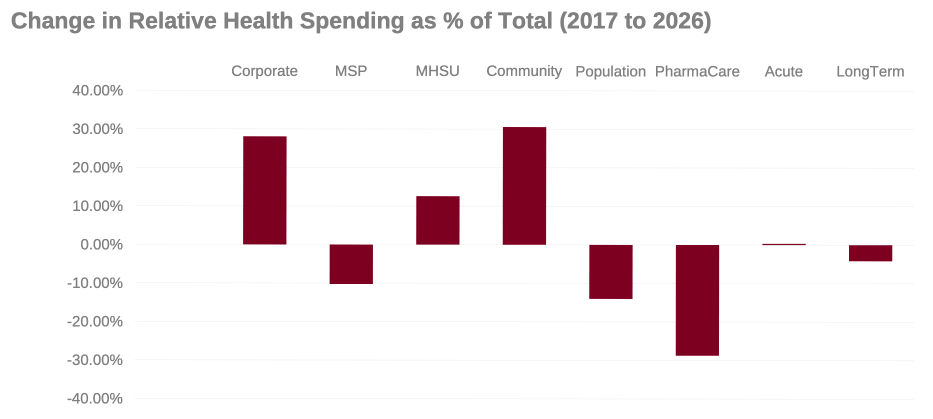
The chart shows the change in health spending priorities since the NDP took power. The two big relative growth areas are "corporate" (health authority head office admin/bureaucracy) and "community" (various admin-heavy primary care programs managed by health authorities, e.g., PCNs, UPCCs), each up over $2 billion in spending (> 2.5x increase in 9 years).
Note: absolute spending across all areas increased, from 1.49x to 2.73x. The chart shows relative growth of each area.
This doesn't even begin to cover the growth in administration within program spending, e.g., in hospitals. In absolute terms, "acute" care is the largest area of spending, at > $18 billion (43% of total), doubled since 2017.
The goal is to reduce the number of administrator-heavy, top-down programs which currently allocate many resources to front-lines by short-term, one-off application. Instead, shift control of resources to front lines through rules-based systems (like MSP), which will both reduce their administrative burden and ensure a better alignment with actual needs.
Full performance audits of health authorities should also help to reduce redunancies, duplication of effort, and ineffective financial controls (such as we've seen at UPCCs, which are one small piece of all this).